03Case study · Atalma – Vido
Redesigning a Performance Insights Tool for Node Operators
A unified monitoring experience that helps validators spot issues faster — across multiple blockchain networks.
- Company
- Atalma – Vido
- My role
- UX Designer
- Period
- 06/2025 – 08/2025
- Team
- Design Lead, UI Designer, Brand Designer, Client PM

Challenge
The platform had grown fragmented. Inconsistent navigation and poor discoverability made key features hard to find for new users – and with every new blockchain network, scaling became as urgent as simplifying.
Solution
A redesigned validator monitoring experience that makes Vido’s full value easy to discover – with clear navigation and a structure built to scale across multiple blockchain networks without fragmenting the interface.
Approach
- Analyzed cross-network workflows and requirements to define a consistent experience model that could scale with future integrations.
- Facilitated iterative decision-making with the client through structured feedback loops, using each round of input to refine the solution.
- Restructured data-heavy interfaces to surface critical information faster and reduce cognitive load for node operators.
- Created an end-to-end product blueprint that brought together all UX decisions, user journeys, navigation, views, and system behaviors to guide UI design and implementation.


Iterative exploration of one network (ICP) From uncovering problem spaces to a refined interaction proposal.
Outcome
- Shipped a unified interface that works consistently across multiple blockchain networks without custom-casing each one.
- Resolved the discoverability problem identified in the brief — key functionality surfaced through a clear two-level navigation hierarchy.
- Simplified data-heavy views so operators can interpret performance at a glance.
- Established a scalable design foundation that accommodates new network integrations without requiring a redesign each time.
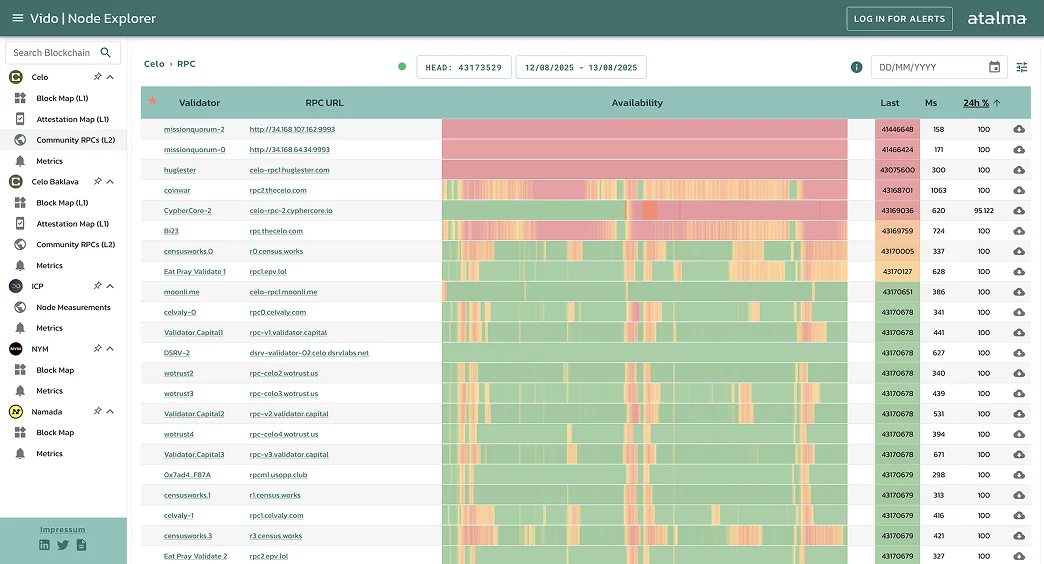

Before and after Before: fragmented navigation with poor discoverability. After: unified hierarchy with consistent interaction patterns.
Highlights
- Scalable Cross-Network Architecture Unified multiple blockchain networks into a single extensible framework while preserving network-specific workflows.
- Faster Operational Insights Simplified block map visualizations through clearer hierarchy and status encoding for quicker issue detection.
- UX-to-UI Handover Resolved all open UX questions and defined the overarching navigation structure, giving the UI designer a clear foundation without needing further UX input.

Learning
Solving one network in depth first gave us patterns that scaled to all the others – depth before breadth paid off.